
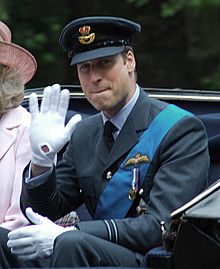

On November 16, Prince William of Wales announced his engagement to his girlfriend of more than eight years, Catherine (Kate) Middleton. It was the moment that millions had been waiting for with bated breath.
Royal-watchers released said breath with a joyful exhalation and then began bloviating about what it all meant (mine to follow); and manufacturers from Stoke-on-Trent to Shanghai released the work orders for the commemorative tchotchkes: the tea towels, plates, thimbles, and spoons, and all manner of junk that in fifty years' time will become treasured scraps of memorabilia.
But there is something exciting about a royal wedding, especially this royal wedding. William's parents did not wed in love. On July 29, 1981, when those of us who watched Charles and Diana walk down the aisle of Westminster Abbey, could we have imagined the sorrow that lay ahead and the tragedy that would end Diana's life at the age of 36? William and Kate give us the chance to believe in a royal happily-ever-after again.
And there is an added significance to William's choice of bride. You've heard ad nauseum that Kate Middleton (she will be known as Princess Catherine after her royal wedding on April 29, 2011) is a "commoner."
Well, Diana, was a commoner, too. So was Elizabeth the Queen Mum, born Elizabeth Bowes-Lyon. A commoner is someone who is not of royal birth. BUT in the past, the heirs to the throne have wed commoners who were born to the purple, so to speak, women of noble lineage. For example, the Queen Mum was the daughter of the 14th Earl of Strathmore and Kinghorne. Diana's father was the eighth Earl Spencer and her noble lineage goes back several generations farther than the Windsors' does.
What makes Kate Middleton special is that her background is not remotely aristocratic. Her father Michael was a flight dispatcher and airline officer for BA, where her mother Carole (née Goldsmith, as was I -- so I'll be eagerly anticipating my wedding invitation) was a flight attendant. The entrepreneurial Carole Middleton later started a party planning company for children, Party Pieces, which took off, so to speak, landing the family in financial clover. Consequently, through the dint of her parents' hard work, Kate was able to grow up in soft surroundings and attend the best schools.
The last time an heir presumptive to the British throne wed a true commoner--one absent all aristocratic blood--was in 1660 when James, Duke of York, the younger brother of Charles II (and the future James II; 1633-1701), clandestinely wed the zaftig brunette Anne Hyde (1637-1671).


Here's the story of James and Anne, excerpted from my book ROYAL AFFAIRS: A Lusty Romp Through the Extramarital Adventures That Rocked the British Monarchy.
The prodigiously buxom and flirtatious Anne Hyde was the daughter of Edward Hyde, a Wiltshire lawyer who turned to politics, becoming Charles II’s chancellor. Her contemporaries noted her intelligence, though they admitted she was not very pretty; in fact, Anne was most often described as a cow. A hearty eater during an era when slenderness was the vogue at court, the girl’s booty came in for some serious ribbing in a popular rhyme:
With chanc’lor’s belly, and so large a rump,
There, not behind the coach, her pages jump.
For several years before the Restoration, Anne had been a maid of honor to Mary, the Princess Royal, sister of Charles and James. But it was in Paris at the exiled court of the Queen Mother Henrietta Maria where Anne first met Mary’s brother James, the Duke of York.
The stuttering duke was stiff and reserved, with a downer of a personality, but by all accounts, James, tall, blue-eyed, and fair, was even more of a rake than his less classically handsome brother, Charles. It certainly wasn’t charm or affability that was the chick magnet—in fact, James was considered rather slow and plodding, particularly compared to the exceptionally bright and witty Charles. But then again, James didn’t attract the beauties of the age, as did his elder brother. On James’s embracing of Catholicism as well as loose women, Charles observed, “My brother will lose his throne for his principles and his soul for a bunch of ugly trollops.” He jested that James’s mistresses were so universally hideous that his priests must have given them to the duke as penance.
With Anne Hyde, however, “dismal Jimmy” (as Charles’s famously clever mistress Nell Gwyn called him) must have scintillated. Apparently their affair grew passionate after the exiled court had moved to The Hague. After the Restoration, Anne’s father sent for her, and she returned to London, fat and glowing—but as Anne was always fat and glowing, her father didn’t notice that she was also pregnant.
Hyde should have congratulated himself on the fact that his daughter had inherited his canny political skills, because in August 1659, Anne had successfully convinced the duke to sign a marriage contract. After that, they cohabited intermittently and clandestinely as man and wife.
On Anne’s return to England, realizing they’d be caught sooner or later, James sneaked into Worcester House, her father’s home, with an Anglican chaplain in tow. The chaplain married Anne and James in a private ceremony on September 3, 1660. Only after they were legally wed did Anne’s new husband throw himself upon the king’s mercy, begging him to allow them to publicly marry.
King Charles summoned Chancellor Hyde, a portly Polonius who had known nothing of his daughter’s affairs until the news was broken to him by two of his friends, the Marquis of Ormonde and the Earl of Southampton. Hyde assured the monarch that as soon as he got home to Worcester House, he would toss Anne out into the street as a strumpet. At the suggestion that Anne might actually be married, the politician then changed his tack, ranting that he would sooner see his daughter be the king’s whore than the duke’s wife—and if Anne were really married to James, she should be thrown into a dungeon in the Tower of London and an Act of Parliament passed to behead her.
“And I shall be the first man to propose that to Parliament!” Hyde shouted.
Charles endeavored to smooth things over, but poor Anne ended up locked in her room. However, Anne’s sympathetic mother managed to sneak the duke into her daughter’s chamber for conjugal visits.
But Anne, a mere commoner, had unintentionally created an international incident.
The Queen Mum, Henrietta Maria, came over from Paris “to prevent so great a stain and dishonor to the Crown.” Then a group of courtiers was enlisted to convince James of his wife’s rampant promiscuity—and therefore, her unsuitability to be his duchess. Anne was traduced by men who had never even met her, all claiming to have bedded her. It seemed that every man in England had crawled out of the woodwork to testify to Anne’s lasciviousness, each sworn statement more outlandish than the last.
Charles didn’t believe a word of it, and assured his increasingly livid chancellor that his daughter was being unjustly slandered. As Anne lay abed, the birth of her baby imminent, the king sent his most trusted ladies to attend her.
But that wasn’t the end of it. Anne, shrieking with labor pains, was forced to endure another torment. The oh-so-sensitive Bishop of Winchester visited her bedside and demanded, “Whose child is it of which you are in labor? Have you known any man other than the Duke of York?” Anne responded in the negative, and probably spat out a lot of other negative things to the bishop besides.
Enter Henrietta Maria, in high dudgeon at Dover, ready to defend her son’s good name and tar Chancellor Hyde with the brush of treachery for daring to marry an undeserving creature of his own lowly brood into the royal house—little realizing that she and the chancellor were on the same side.
Charles stepped in and averted a crisis by making Hyde a baron, with a gift of £20,000 (well over $4.3 million today) to sustain the honor. By the time the groom’s mother reached London, she was greeted by the bride’s father, now Baron Hyde of Hindon, a peer of the realm. The following year Charles made Hyde Earl of Clarendon.
The dowager queen’s argument about the worthiness of Anne Hyde’s family had thus been gracefully nipped in the bud, and eventually, Henrietta Maria grew to accept her new daughter-in-law.
Anne was clearly the dominant partner in the marriage, yet she could not prevent James from returning to his rakish ways soon after their union was legalized in the eyes of family and state. “The duke is in all things but his codpiece led by the nose,” Samuel Pepys observed.
Anne coped with her husband’s frequent infidelities by overeating. She was also perpetually pregnant, giving birth to eight children in nearly as many years, but only two daughters, Mary and Anne, survived to adulthood. The rest died in infancy.
After suffering from cancer for three years, Anne finally succumbed to the disease in 1671, a few weeks after giving birth to her eighth child. In her final days, she also became a secret convert to Catholicism.
One evening after enjoying a hearty dinner at Burlington House, Anne retired to pray, and then collapsed in the chapel. A frantic James sent for the Bishop of Oxford, but by the time he arrived, Anne was incoherent.
She died at St. James’s Palace in her husband’s arms, with the words “Duke, Duke, death is terrible. Death is very terrible.” She was buried in Westminster Abbey.
Anne’s two daughters each went on to become Queen of England, and both would make their mark in British history. Mary, born on April 30, 1662, would marry William of Orange and become a key player in the Glorious Revolution that would overthrow her own father and place herself and her husband on the English throne. Her younger sister, Anne, born on the sixth of February in 1665, would inherit her mother’s corpulence as well as her father’s crown. Under Queen Anne, England and Scotland were combined into a single nation in the Act of Union signed on May 1, 1707, thereby making Anne Hyde’s younger daughter—the issue of the woman who was such a “stain and dishonor to the Crown”—the first monarch of Great Britain.
So, are you a royal watcher? Do the impending nuptials of William and Kate have you excited or are you more fascinated with their place in the pageant of history?




.jpg)


